Somewhere east on Olympic, or possibly Pico Blvd, one of those long horizontal streets that carry traffic through the city's successive neighborhoods like a core sample of its demography, there passes Merkato Ethiopian Restaurant & Market on Fairfax, in that stretch of Little Ethiopia between Olympic and Whitworth where the traffic has been described as one of LA's most infamous gridlocks.
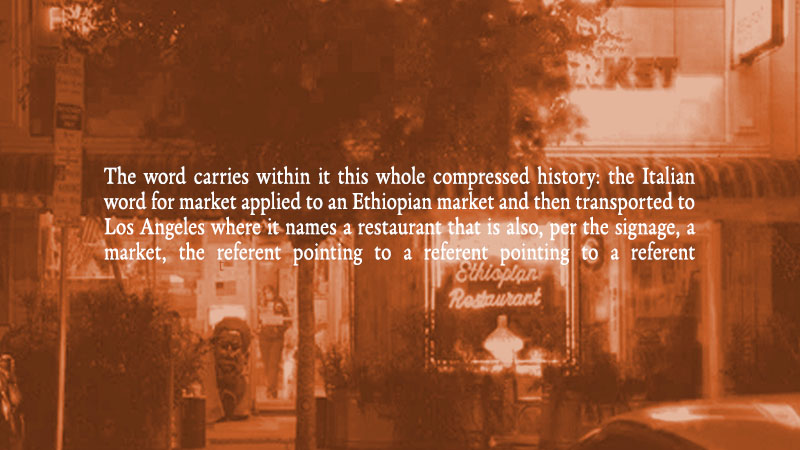
The word "merkato" is doing something. It is a loanword from the Italian "mercato," itself derived from the Latin "mercatus," meaning trade, which arrived in Ethiopia during the Italian occupation of the 1930s and attached itself to the great open-air market in Addis Ababa, the largest in Africa, a sprawling commercial zone that predated the Italians and would have been called something else before they came and renamed it in their own image. The word carries within it this whole compressed history: the Italian word for market applied to an Ethiopian market and then transported to Los Angeles where it names a restaurant that is also, per the signage, a market, the referent pointing to a referent pointing to a referent, the word "market" having traveled from Latin to Italian to Amharic to American English, picking up and shedding meanings at each crossing, arriving finally on a strip mall sign in a form that contains, for anyone who cares to look, the residue of empire.Through car windows at this hour there is visible tables and chairs, a counter, and somewhere off to the side a refrigerator case or shelf with items for sale, waiting with a stillness akin to objects in museum, preserved, but without having been removed entirely from circulation.
Continuing east the word 'market' begins to accumulate in that way words do when noticed: Buna Ethiopian Market, also on Fairfax, then Susuru Ramen Bar + Marketplace on Hollywood Boulevard, housed in a strip mall near Thai Town whose particular shade of beige suggests a construction date somewhere between 1987 and 1994, the golden age of Southern California strip mall construction.
The "marketplace" at Susuru is, as far as can be determined from the exterior signage and what glimpses are available through the window, a ramen shop. Even after eating there, even after the second time, even after making a point of looking closely any patron would either come to the conclusion that the marketplace component does not exist or exists in a form so subtle as to escape detection. Possibly there is a shelf somewhere that went unnoticed. Possibly the marketplace is the menu itself, conceived as a miniature economy of noodles with each bowl representing a kind of investment, a commitment of resources (twelve to sixteen dollars at current prices) in exchange for an experience that will last approximately twenty-five minutes and then exist only in memory, the memory itself fading over subsequent days until all that remains is a vague sense of having eaten ramen at some point.
Further east the pattern continues: in Silver Lake there's Night+Market Song, the Thai restaurant that's been somehow continuously trendy for a decade, known for the long wait and the volume level, and Botanica Restaurant & Marketplace, the farm-to-table place with the "good wine pairings". North into the Valley there's Follow Your Heart Cafe & Marketplace in Canoga Park, the vegan institution since 1970 where the word 'market' was grandfathered in from when it actually a health food store with a cafe attached. South into Koreatown there's Open Market on 6th Street, which is a sandwich shop. And if you keep going east, all the way out to San Dimas, you'll pass a shuttered Boston Market, a rotisserie chicken chain from the 80s that expanded rapidly then contracted and now no longer has any locations in Boston, and where no commerce occured outside of rotisserie chicken sales.
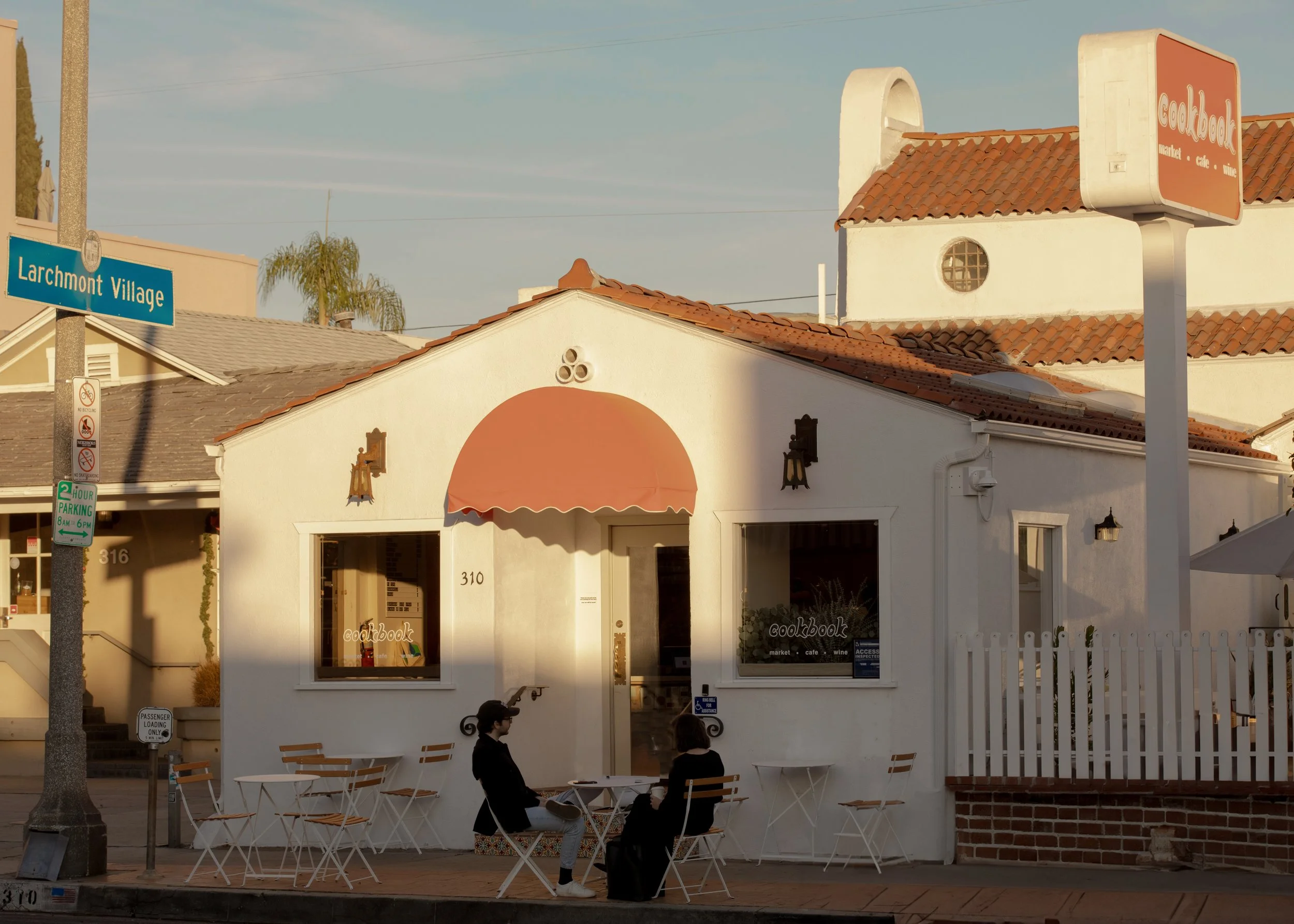
Just 15 minutes away, at Cookbook on Larchmont, one of three locations owned and operated by the Jon and Vinny hospitality group, who purchased what was once a genuine hole-in-the-wall mini market in Echo Park and have been expanding the brand ever since with the kind of careful attention to aesthetic consistency that characterizes the more successful restaurant empires, the Larchmont location having opened in late 2023 in a 1920s building with a white picket fence and an orange billboard, the whole thing calibrated to produce a feeling that might be described as "nice," the kind of nice that costs more than regular nice but feels, somehow, worth it.
The thing about Cookbook, and this is true of places like it, the growing category of establishments that might be classified as "Micro-groceries" , Cafe & Markets , Restaurant-Retail Hybrids or just Nice Places With Shelves, is that a household could theoretically be provisioned there. There is bread. There are eggs. There is, in the freezer, something called Little Sparrow dumplings, which retail for approximately twenty four dollars for twelve dumplings, or two dollars per dumpling, as compared to the Trader Joe's dumpling, which retails for approximately four dollars for twelve dumplings, or thirty-three cents per dumpling, a price differential that represents, in some sense, the entire phenomenon under examination here, the question being what exactly your money is purchasing, what service or feeling or identity it represents, whether the Little Sparrow dumpling is in fact six times better than the Trader Joe's dumpling or whether the pricing reflects something else entirely, something that has nothing to do with dumplings per se and everything to do with shelves, with context, with the demographic of people who shop at the kind of place that sells twelve-dollar dumplings.
Everything at Cookbook has been selected by someone with a title like 'Head of Provisions' or a bio that reads: "After ten years in consulting, [Name] followed a lifelong dream to bring farm-to-table accessibility to the modern home cook." Someone with a discerning eye and a wholesale account and this selection is itself part of what the twelve dollars is purchasing: the relief of not having to choose among seventeen brands of frozen dumpling at the regular grocery store, standing there in the frozen foods with the cold air spilling out of the open freezer case onto your cheeks while the freezer door hastily fogs up, trying to remember which brand you bought last time and whether you liked it, trying to decode the nutritional information and the ingredient lists and the claims of "artisanal" and "small-batch" and "chef-crafted," none of which mean anything legally, the whole experience producing a kind of low-grade decision fatigue that accumulates over a lifetime of grocery shopping into a general exhaustion with the entire project of feeding oneself, an exhaustion that Cookbook promises to alleviate, for a price, by making the choice for you, by saying in effect: trust us, we know about dumplings, this is THE dumpling, the only dumpling you need to consider.
Zinc Cafe & Market in the Arts District opened in 2014 in a building on Mateo Street with exposed ductwork and a peaceful courtyard and a mature olive grove, the whole industrial-creative package that by 2014 had become the default arrangement for the kind of neighborhood that used to be warehouses and is now restaurants and galleries and creative agencies. The "market" at Zinc is a set of shelves near the front with prepared foods and cookbooks and ceramic vessels and hot sauces with illustrated labels featuring hand drawings of peppers or flames or cheerful farmers in an attempt to tell a story about provenance and craft and authenticity in a way that would justify a price point of eleven or twelve dollars for five ounces of hot sauce, which is not unreasonable if you think about it in terms of cost per use, a bottle lasting perhaps two months of regular use, which works out to maybe twenty cents per application, a small price to pay for the feeling that accompanies this particular hot sauce.
The website describes Zinc's market component as offering "an abundance of prepared foods such as salads, entrees, appetizers and desserts to enjoy at Zinc or home," the word "abundance" performing significant labor in that sentence, the abundance in question being approximately forty items in a refrigerator case and on some shelves, which is not abundance by most definitions (abundance being perhaps Costco, or the cereal aisle at a conventional supermarket, or the number of results returned by a search for "Coffee" on Amazon, which is currently at 8742) but which is abundance relative to the careful scarcity that characterizes the Cafe & Market.
The ampersand in Zinc Cafe & Market is doing work too. "Cafe and Market" would suggest two things conjoined, two separate entities that happen to coexist in the same space. "Cafe & Market" suggests something else: a ligature, a single branded entity, the ampersand serving as a kind of weld or suture holding the two concepts together into a unity, a unity that exists primarily in the realm of signage and branding but that nonetheless produces a real effect, a feeling that one has entered not a cafe next to a market but a Cafe & Market, a new kind of thing, a hybrid species that did not exist before someone thought to combine the words with that particular symbol.
The word "market" has always carried within it a sense of plurality, of multiple vendors and products, of options and browsing. The farmers' market, the flea market, the fish market, the night market: all of these preserve something of the original sense, the feeling of a space where commerce happens provisionally, portably, chaotically, where independent operators have gathered their wares from disparate sources and assembled them temporarily for exchange, the assembly to be disassembled at day's end, the vendors returning to their farms and workshops and fishing boats, the space reverting to parking lot or plaza or empty field until the next market day.
Then the supermarket arrived: a single operator, a permanent structure, the goods already gathered and arranged on shelves by hands that, to the customer, were invisible, the hands belonging to night-shift stockers whose labor made possible the magic of the fully provisioned store, the store that was always ready, always open (or nearly always, the 24-hour supermarket representing the logical endpoint of this development), the customer never having to wonder whether the bread would be there because the bread was always there, the bread existed in a state of perpetual availability that required no planning, no timing, no knowledge of market days or seasonal variations, just the assumption, which became so deeply embedded as to be unconscious, that the bread would be there when you wanted it.
And yet the word "market" was retained, modified only by that prefix "super," which in the 1930s must have sounded thrillingly futuristic, like "superstar" or "superhighway" or "Superman," all of which emerged around the same time, the 1930s being a decade when the prefix "super" was doing a lot of work, when attaching it to a word could make that word seem to transcend its ordinary limitations, to become something more than itself, so that the supermarket was not merely a market made larger but a market that had achieved a kind of apotheosis, a market that had left behind the chaos and uncertainty of the farmers' market and achieved the clean, well-lit permanence of an institution.
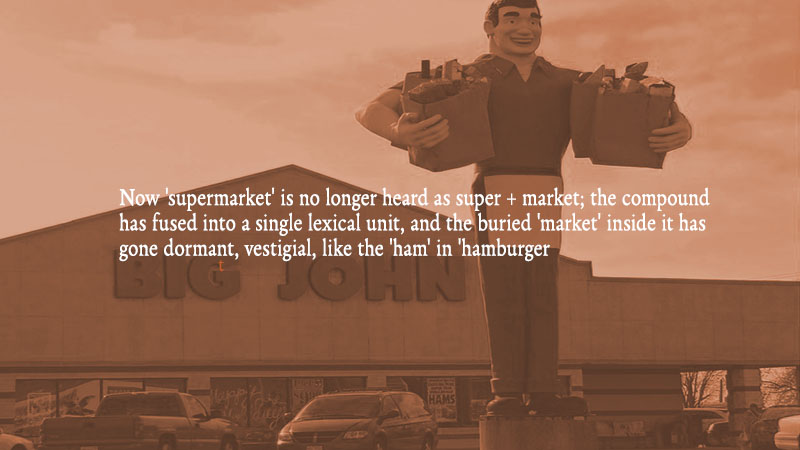
Now 'supermarket' is no longer heard as super + market; the compound has fused into a single lexical unit, and the buried 'market' inside it has gone dormant, vestigial, like the 'ham' in 'hamburger,' which derives not from the cured pork product but from the German city of Hamburg, the hamburger being a Hamburg-style steak that emigrated to America and lost its hyphen and its origin story somewhere along the way, the ham and the burger now locked together in a word that no one parses, that no one thinks about. Whole Foods Market, Sprouts Farmers Market: no one says the full names, the Market shed somewhere between the trademark filing and the mouth, because to say them would be incantation, conjuring the farmers' market onto a retail pad in Tustin, or Chino Hills, or Porter Ranch between the Target and the private-equity owned urgent care center, across from the Chili's and the two fast-casual bowl places, the whole complex called something like 'The Commons at Vista Crossing,' designed in an office park and financed by a REIT and optimized for SUV turning radius, the ghost summoned into a place that killed it and now wears its name, another hamburger amongst hams.
And then there is the superette. The word appears on storefronts around Los Angeles with increasing frequency: Yobeoseyeo Suprette, Bakers and Baristas Suprette in Artesia (the "market" counterpart to the original restaurant), DTLA Cheese Suprette, Saugus Suprette. The suffix "-ette" performs a diminutive function, the same linguistic operation that gives us kitchenette and dinette and cigarette and bachelorette, taking something and making it smaller, cuter, more manageable. So the superette is a super that has been shrunk, a market that is less than a market, the prefix and the suffix working against each other in a kind of oxymoronic tension: super but small, grand but diminished, a place that borrows the signifiers of the supermarket while explicitly announcing its departure from them.
The superette occupies a strange retail category between a grocery store, a convenience store, and a liquor store. It is full of DTC brands and small-batch products and items with illustrated labels, the kind of inventory you might find in a Cafe & Market but without the cafe, without the tables and chairs, without the pretense of being a destination. The superette is what you find when you are walking somewhere else and notice an overly designed and pleasant storefront and think: what is this? The superette is, in effect, the shelf that has been emancipated from the cafe, allowed to exist on its own terms as market, to become the whole store rather than a decorative appendage. The word itself, "suprette" (often spelled without the second "e" in "super," a further condensation), signals this status: we are not a supermarket, but something that requires a different word that wears its smallness as a badge.
This is why, when someone says "I'm going to the market" versus "I'm going to the supermarket," these register as different propositions, the first suggesting Sunday morning, a tote bag (the tote bag probably from a podcast, or NPR, or the New Yorker, or a museum, or a bookstore), a willingness to be surprised, to discover something, to come home with an item not on any list. The supermarket is necessity, routine, the weekly thing, the overhead white lighting and the self-checkout and the drive home with the plastic bags in the trunk, the whole experience engineered to be as frictionless as possible, the supermarket visit leaving almost no trace in memory, just a vague sense of having acquired provisions, having restocked the household.
"Store" is neutral, functional, corporate: the word itself seems designed to be forgotten as soon as it is spoken. "Market" has a romance to it, a feeling of the souk and the bazaar and the mercado, places where commerce is personal and goods are loose in bins and baskets rather than shrink-wrapped on shelves, places where you might need to haggle, or at least could haggle if you wanted to, the possibility of haggling being part of the feeling even if no one actually haggles anymore, the haggling being something that other people do in other countries, the other people being more connected somehow to an older way of doing things, the way things were done before the supermarket, before the barcode, before the self-checkout, before the algorithmic pricing that changes minute by minute based on demand and inventory and competitor pricing and weather and who knows what else.
And here the thinking begins to branch in directions that were not anticipated, because "market" means something else entirely when speaking of "the markets," Wall Street, the stock exchange, the abstracted arena where capital flows and fortunes are made and lost by algorithms executing trades in microseconds, the algorithms having no concept of what a market is, no memory of the bazaar, just instructions to buy and sell based on signals that are invisible to human perception, the human traders having been largely replaced by these algorithms, the trading floor that used to be full of shouting men in colored jackets now quiet, the shouting men having been rendered obsolete by code running on servers in data centers in New Jersey, the data centers located in New Jersey specifically because of their proximity to the exchange, every millisecond of latency representing a potential loss, the physical distance between the server and the exchange having become a competitive advantage.
This is "market" as mechanism, the emergent behavior of millions of transactions aggregated into something that seems to have moods: the market is nervous today, the market responded well, the market has priced in the risk. The language anthropomorphizes the mechanism, attributes feelings and intentions to what is, in essence, a very large spreadsheet that updates very quickly, the anthropomorphization being necessary for news anchors and analysts who need to explain market movements in terms that make narrative sense, that have characters and motivations, that can be discussed the way one discusses the behavior of a person rather than the output of an equation.
The Original Farmers Market on Fairfax, which has operated since 1934, is a market in the old sense. Every major city now has its market, the market as civic amenity, as tourist destination: Pike Place, Reading Terminal, Grand Central Market, Chelsea Market, Jean-Talon, the market having joined the art museum and the waterfront as mandatory infrastructure, a semiotic anchor, proof that the city has history. They smell different but the inventory is the same: the regional specialty (salmon, maple syrup, tacos, cheesesteaks), the honey guy, the olive oil guy, the hot sauce stall, the empanada stall, local color templated onto a universal structure
"the market" in the financial pages is something else entirely, a metaphor that has consumed its referent, that no longer points to any physical place or collection of vendors or field of browseable goods but to an abstraction, a concept, a way of describing the aggregate behavior of millions of actors whose individual decisions produce outcomes no one intended and no one fully understands.
And then there is the "marketplace" of the internet. Amazon. Alibaba. eBay. Etsy. Platforms that aggregate millions of sellers into a single searchable interface, that present the illusion of a market, the plurality and chaos and browsability of a market, while being in fact something quite different: a database, a logistics network, a system of warehouses and drivers and recommendation engines, the recommendation engine suggesting products based on what was clicked on and purchased and searched for, not just by the current user but by millions of other users whose behavior patterns resemble the current user's behavior patterns, the engine constructing a profile, making predictions, surfacing products that the user didn't know they wanted until they saw them, the browsing that feels like freedom being in fact guided, channeled, optimized, the user walking through what appears to be an open marketplace but is actually a maze with walls invisible to the user but very visible to the algorithm, the walls directing the user toward products that maximize some metric, revenue presumably, or engagement, or some combination of factors known only to the engineers who built the maze.
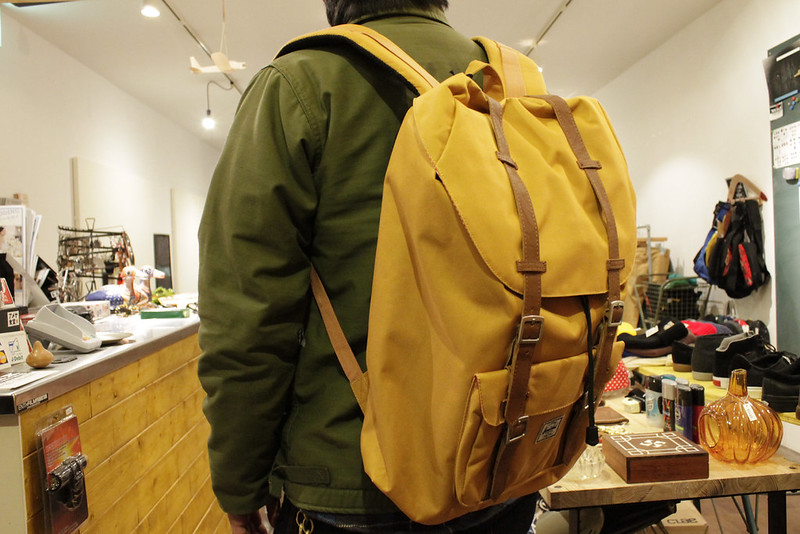
A person can sit on a couch and access more goods than any physical market in human history has ever contained, can browse for hours without speaking to anyone, the goods arriving in boxes, the vast machinery behind them visible only in error, only when something is lost or damaged or left in the rain. Scroll long enough and what surfaces is the residue of the same era that spawned the Market: search 'backpack' and there's Herschel Supply Co., search 'grooming kit' and there's Bradley Mountain Gentleman's Dopp Kit, search 'candle' and there's P.F. Candle Co., the Supply Cos. and Provisions Cos. and Candle Cos. still lodged in the algorithm from 2012, 2013, the same post-recession moment with an unyielding appetite for things that looked handmade or local or heritage or at least wore the names.
Herschel Supply Co., founded in 2009 and named after a town in Saskatchewan where the founders' great-grandparents once lived, a town with a population of approximately thirty people, the town being mostly wheat fields and a gas station and a memory of an earlier time when the town was larger, more vital, before the young people left for the cities and the farms consolidated and the population dwindled to thirty, the thirty remaining residents presumably surprised to learn that their town had become a brand, that people in 2010s Brooklyn and Silverlake were carrying Herschel backpacks without any idea that Herschel was a real place.
These naming patterns operate on a shared axis of distinction, a way of signaling that one is not at the Bar & Grill, not at the Sports Bar, not at the Family Restaurant with laminated menus and a kids-eat-free policy. The 'Supply Co.' promises a past, a heritage, a somewhere the product came from. The '& Market' promises a present, a continuity, a scene where the product exists now, the feeling that this place and these objects and the people shopping here are all part of the same moment.
Where did this come from? The genealogy is speculative: maybe the 2008 financial crisis, which made people suspicious of anything that looked like a bank. Maybe Eataly, which opened in New York in 2010 and demonstrated you could charge premium prices for groceries if you put some tables in the middle. Maybe the whole Brooklyn-farmhouse-industrial complex, the reclaimed wood and Edison bulbs that spread from Williamsburg to every Target in America and required a vocabulary, and 'market' was one of those words, available, underused. Or maybe it goes back to Whole Foods, to the 1980s, when John Mackey called his natural foods store Whole Foods Market and the word 'Market' carried weight even then, before it went vestigial, before it became just Whole Foods. Or maybe the genealogy doesn't matter. The words create the categories. The categories create the demand. The demand creates storefronts. Storefronts create more words.
Herschel already feels like a period piece, 2012, the Supply Co. having been written about and memed until it went flat. But the & Market kept going, kept mutating, the superette being proof that the vocabulary survived even as the original moment passed, new ones still opening, the words still working.
As of the publishing of this article, "Zinc Cafe & Market is now Zinc Cafe & Bar. The West Hollywood location closed. The ampersand remains but the Market is gone, shed like the Market in Whole Foods Market, the word having honored its lease for a decade and then quietly removed from the signage, the ligature cut. The shelves near the front with the ceramic pour-over drippers and the hot sauces with illustrated labels, the forty items that constituted 'abundance,' gone, replaced by a bar, by natural wine, by whatever the next thing is. The Market was 2014. The Bar is 2025. The same space, the same exposed ductwork, the same mature olive grove in the courtyard, but the word that once signaled something, that once promised plurality and browsing and authenticity, no longer doing enough generating enough value to justify its presence on the sign. The dripper that promised twelve minutes of intention is probably on clearance somewhere, or in a landfill, or on someone's counter gathering dust, the mornings having never quite arrived, or having arrived and been forgotten.